
How Often Should You Ask for Reviews? The Survey Data
Let's get something straight: every owner wonders how often to ask for reviews — and almost everyone gets the answer wrong.
There are two kinds of owners on this question. The timid ones, who ask never — terrified of bothering people. And the spammy ones, who ask everyone, constantly, with all the subtlety of a car alarm.
How often should I ask my customers for a review?
Every time you deliver a great experience — which, for a serious operator, means constantly.
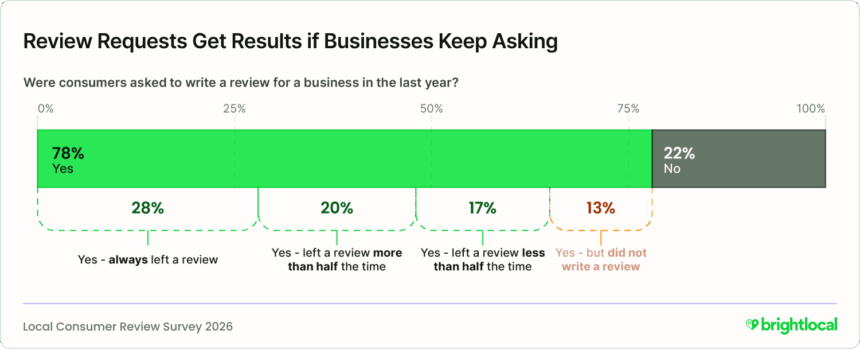
This isn't my opinion. BrightLocal's 2026 Local Consumer Review Survey — 1,002 U.S. adults, published February 2026 — found that 83% of people asked to leave a review went on to leave one. Read it twice. The single biggest driver of review volume is the ask itself.
And willingness is growing: 28% now say they'll "always" write a review if asked — nearly double the 16% in 2025. Nearly everyone (94%) is open to writing one. You're not begging strangers. You're opening a door they want to walk through.
BrightLocal's own conclusion from the data: "Treat review generation as an always-on marketing tactic… Don't be afraid to follow up."
So the answer to "how often?" is: as often as you earn it. Systematically. On purpose. A review profile is not a trophy you win once — 74% of consumers only care about reviews written in the last three months. Stop asking for a month and your profile starts dying in public.
Won't my customers get annoyed if I keep asking?
No — and your fear of annoying them is costing you more customers than any ask ever will.
Look at the numbers. 78% of consumers were asked to leave a review in the last 12 months, and 65% wrote one after being asked. Being asked is now as normal as being handed a receipt. Nobody is writing angry letters about it.
Meanwhile, what does turn the market off is a review profile that hasn't moved in months. Customers don't read your silence as politeness — they read it as "nobody's been happy here lately." The timid owner doesn't earn respect for his restraint. He gets skipped.
Can I offer a discount or freebie to get more reviews?
Absolutely not — Google says so in writing, Yelp says so louder, and the federal government fines people who try.
Three hard rules. Memorize them, because violating any one of them can torch your profile:
Rule #1: No incentives. Ever. Google's own review policy page states that offering incentives — free or discounted goods or services — for posting, changing, or removing reviews is "fake & misleading content" and strictly prohibited. Reviews get removed. Profiles get restricted. Not a gray area; printed policy.
Rule #2: On Yelp, don't ask at all. Yelp's official "Don't Ask for Reviews" policy forbids asking customers, friends, and family; bans staff competitions to collect reviews; and warns incentives can also be illegal. Yelp's software actively hunts solicited reviews. Play a different game on Yelp: deliver the experience and let reviews come on their own.
Rule #3: No review gating. You cannot pre-screen customers, sending only the happy ones to Google while diverting the unhappy ones to a private form. Selective solicitation is treated as deceptive, and the FTC's Final Rule on fake reviews makes incentives a federal compliance issue.
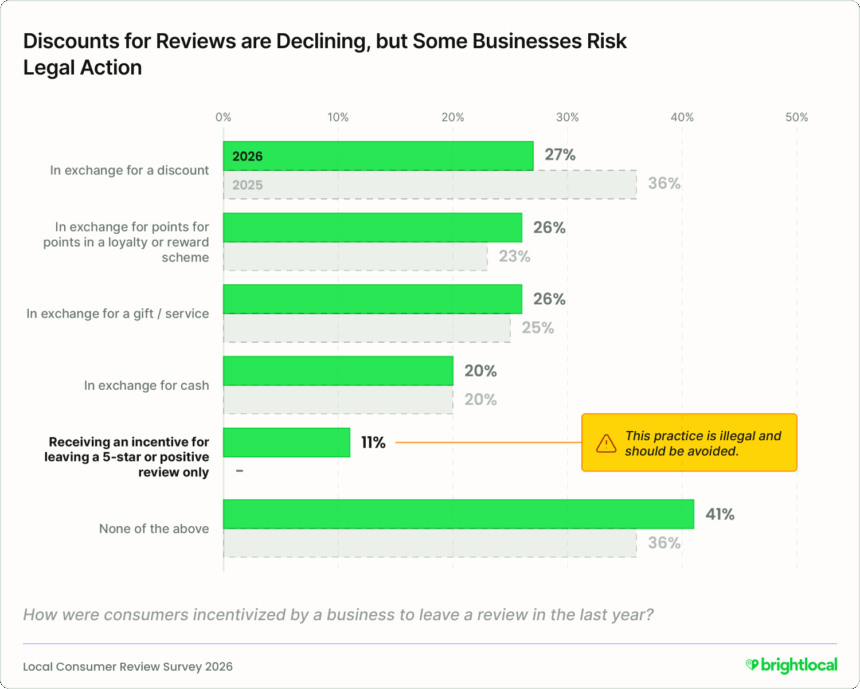
The bright line: ask everyone, ask for honest feedback, offer nothing in return. BrightLocal found 11% of consumers were offered an incentive for a positive review — those businesses aren't clever. They're gambling with the storefront Google gave them.
What does a review-asking system actually look like?
Four moves, in the same order, every single time. That's the whole system — and it's a system, not a heroic act you do when you remember.
Move 1: Ask at the moment of peak satisfaction. The second the job passes inspection or the appointment ends on a smile. Happy is perishable — shelf life of about twenty minutes. Strike while the grin is fresh.
Move 2: Follow up once, in writing. A short text or email with your review link — Google hands you a free shareable link and QR code. BrightLocal's researchers say it plainly: don't be afraid to follow up. Most owners send zero follow-ups; one puts you in the top tier.
Move 3: Make it one tap. Link on the receipt. QR code on the counter card. Every ounce of friction you remove converts directly into reviews, because 83% of the asked say yes — but only if the door is open.
Move 4: Repeat forever. 74% of consumers ignore reviews older than three months, and 47% won't touch a business with fewer than 20. Your review stream is a pulse the market checks continuously. A system that runs weekly beats a campaign that runs annually, every time.
Marketing is the CEO's job. Never delegate it. The moment "ask for reviews" belongs to whichever employee remembers, your reputation belongs to chance. Build the workflow, train the staff, inspect it like revenue depends on it — because it does.
You don't have a review problem. You have an asking problem.
All the real wealth is in the herd — and the herd talks. Every satisfied customer who leaves unasked is a testimonial that died in the parking lot. Ask, and they will write. Ask rarely, and you disappear. Ask constantly and honestly, and the market does your marketing for you.
Decision & Action Time. ♦♦♦
By the way... do you have a plan for collecting reviews in your business? Don't let it intimidate ya. Go to ReputationGenius for the plan and the tools to make it easy and reliable — for you and your team. Click here.
P.S. One more warning from the survey: 11% of consumers were offered an incentive in exchange for a positive review — and the platforms' AI enforcement is only getting sharper. If any agency, vendor, or well-meaning staffer has ever dangled a discount for stars on your behalf, audit it now. Cleaning it up quietly beats having Google clean it up for you.
Sources: BrightLocal, Local Consumer Review Survey 2026 (1,002 U.S. adult consumers via SurveyMonkey, published February 2026); Google Business Profile Help, "Tips to get more reviews" (incentive prohibition); Yelp Support Center, "Don't Ask for Reviews" policy; FTC Final Rule on Online Reviews (2024).
