Online Review Statistics 2026: What 1,002 Consumers Said
Your next customer has already voted. You just haven't seen the ballot.
Let's get something straight, right out of the box:
Your next customer will decide whether to call you before ever seeing your website, your truck, or your smiling face — staring at a screen, scrolling strangers' opinions of you.
And I can prove it — not with guru hand-waving, but with fresh review statistics from 1,002 American consumers, surveyed February 2026 in BrightLocal's annual Local Consumer Review Survey.
Read these numbers. Then tell me reviews are "something you'll get around to."
What do the 2026 review statistics actually say?
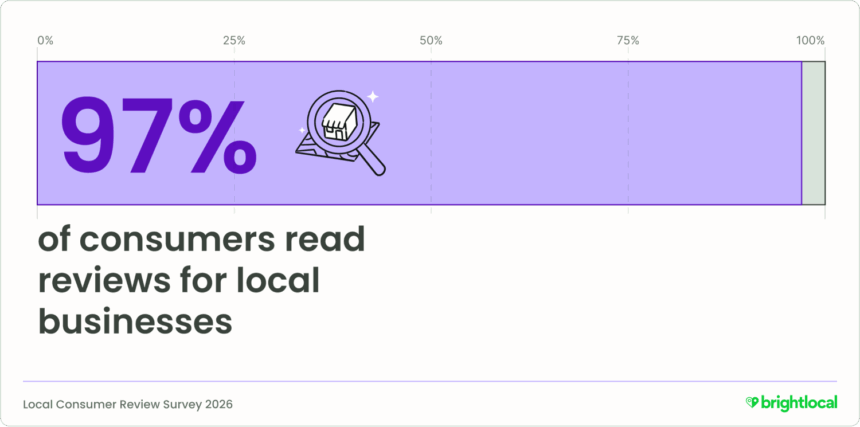
97% of consumers read online reviews before choosing a local business. Not most. Not "a lot." Ninety-seven percent — of every 100 strangers considering your business this month, 97 check your reviews first.
And here's where it stings:
41% read reviews every single time they browse — up from 29% a year ago. The habit is accelerating.
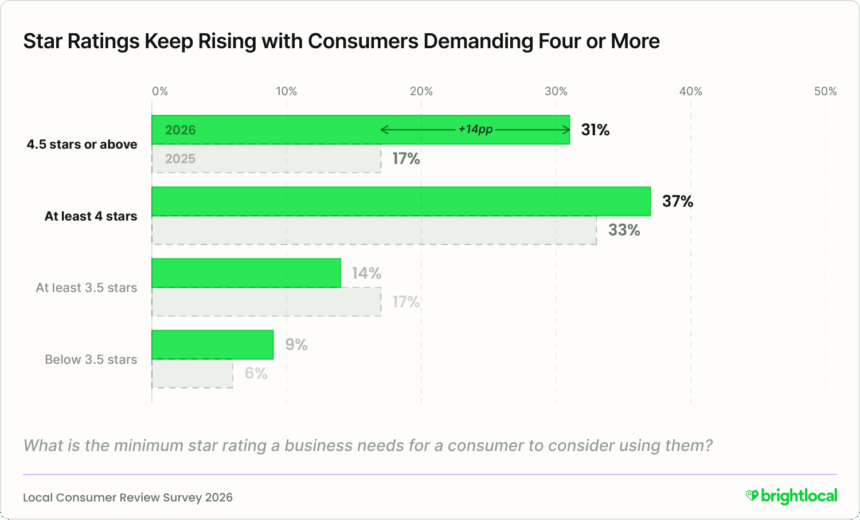
68% will not use a business rated below 4.0 stars — up from 55% last year.
31% will only use a business at 4.5 stars or higher — nearly double the 17% from a year ago.
47% won't even consider a business with fewer than 20 reviews. That's the cover charge now.
A 4.3-star business with 14 reviews — a good business, by any honest measure — is invisible to half the market before the conversation starts.
That's not a marketing problem. That's a locked front door with customers standing outside.
How fresh do your reviews need to be?
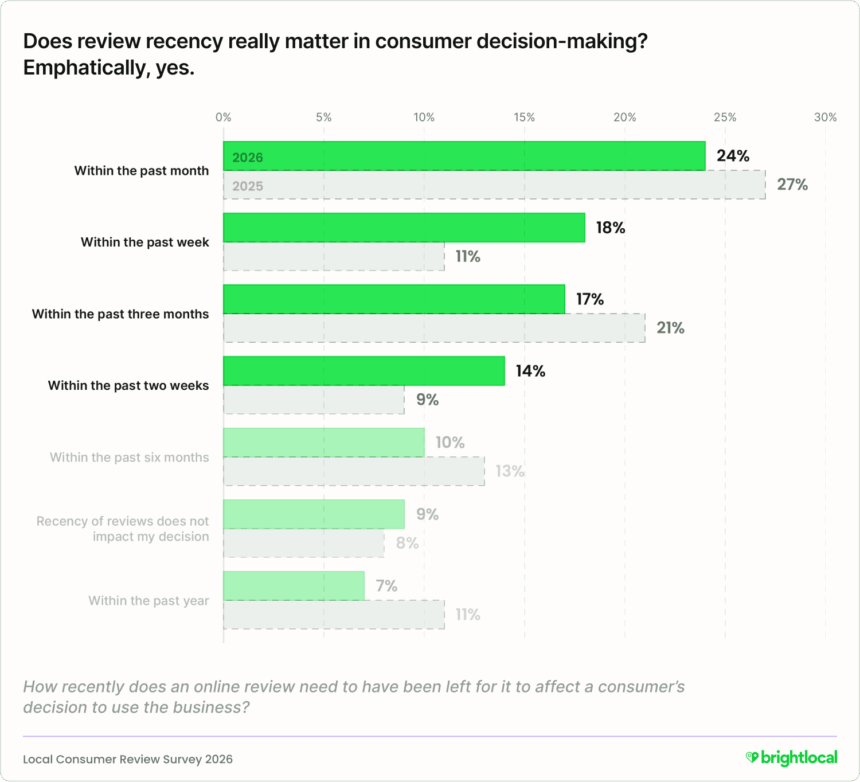
74% of consumers only care about reviews written in the last three months. That's the headline number, and it should rearrange your priorities.
Most owners get blindsided here: they did a review push two years ago, collected a pile of five-stars, and moved on. But nearly a third of consumers — 32%, up from 20% last year — want to see something from the last two weeks. And 44% rank "posted within the last month" as one of the most important factors in a review, right up there with the star rating itself.
Translation: that glowing review from 2024? To today's customer, it's archaeology.
A review profile with a burst of great reviews followed by four months of silence doesn't look "established." It looks abandoned. You might have served 200 happy customers in those four months. Nobody asked them, so nobody knows.
Reviews are not a trophy you win once. They're a pulse the market checks continuously. No pulse, no trust.
Do people still trust online reviews?
Yes — but more skeptically than ever. 97% still read them, while trust in their honesty has been sliding for a decade, dragged down by fake reviews.
Review trust peaked in 2016–2017, when 84% of consumers trusted reviews as much as a friend's recommendation. The 2026 survey puts that number at 49% today — the fakers did real damage getting us there.
The thumb-suckers hear that and conclude "reviews don't matter anymore."
Nuts. Read it again. 97% still read them. 41% read them every time. The behavior didn't decline — the skepticism increased.
And that is the single biggest opportunity in this entire article, so re-read this sentence: when customers are skeptical of reviews in general, a business with a deep, steady, obviously-real stream of recent reviews wins by default. The public agrees: in the same survey, 97% of consumers said businesses caught buying fake reviews should face punishment — 16% want criminal charges or jail time — and the FTC's 2024 rule made buying or selling fake reviews illegal.
Volume plus recency plus responses (89% of consumers expect owners to respond — and templated, copy-paste replies put off 50% of them, by the way) is the closest thing to a forgery-proof reputation that exists. The fakers can't fake a three-year drumbeat. You can build one — if you have a system.
What should a local business owner do Monday morning?
Three things. Not thirty. Three.
1. Make asking automatic, not heroic. Every business owner I've ever met intends to ask for reviews. Intention isn't a system. The businesses winning this game don't rely on remembering — they have a workflow that asks every happy customer, every time, without anyone having to think about it. (Notice I'm telling you the WHAT. The HOW is where specialists earn their keep.)
2. Answer every review like the prospect is reading over your shoulder — because they are. 89% of consumers expect a response, and Google's own review management guidance says your reply is publicly posted under the customer's review, the customer is notified, and they can still change their review after reading it. A thoughtful response to a bad review sells harder than ten five-stars. Silence reads as guilt.
3. Treat 20 reviews and 4.5 stars as the new minimum wage. Below it, you're invisible to half the market. The 4.5-star bar moved 13 points in one year. It will move again. Build the cushion now, while you're choosing to — not later, when you're desperate.
One more number: 54% of consumers visit a business's website after reading positive reviews — up from 32% in 2019. Your reviews are the first touch; your website is the second. Get the order right.
So what's the bottom line?
Two kinds of local businesses exist now: the ones with a living, breathing review profile — and the ones slowly going invisible while insisting "word of mouth is enough."
The survey doesn't care about your feelings. 1,002 strangers told us exactly how they buy. Believe them.
Decision & Action Time. ♦♦♦
Do you have a plan for collecting reviews in your business? Don't let it intimidate ya. Go to ReputationGenius for the plan and the tools to make it easy and reliable — for you and your team. Click here.
Sources: BrightLocal, Local Consumer Review Survey 2026 (1,002 U.S. adults, published February 2026); FTC final rule banning fake reviews and testimonials (announced August 2024); Google Business Profile review management help.
