Google vs Yelp vs Facebook: Where Reviews Get Read
Google vs Yelp vs Facebook: Where Reviews Get Read

Let's get something straight, right out of the box: the Google vs Yelp vs Facebook reviews debate is the wrong fight. Owners ask it like they're picking a favorite child. You're not. You're picking real estate — and the only question that matters is where the buyer actually shops.
Because here's the harsh reality: your reviews don't live in one place. BrightLocal's 2026 Local Consumer Review Survey (1,002 US adults, published February 2026) found the average consumer checks six different review sites before choosing a business. Six. And 97% of them read reviews before they buy. So the question isn't which platform wins. It's which platform does what — and where your limited hours go.
Where do most customers actually read reviews first?
Google. Still. By a lot — even though it's slipping.
The same BrightLocal survey puts Google at 71% of review readers, down from 83% a year earlier. That drop is real, but don't kid yourself: 71% of nearly everyone is still nearly everyone. Google owns the moment of intent — the "plumber near me," the Maps listing, the star rating sitting right there in the search results. A customer standing in your parking lot deciding whether to walk in is reading Google, not Yelp.
But read this twice: where people read and where people write are two different lists. Reviews get written on Google 45% of the time, on Facebook 34%, and on Yelp just 24%. So a lot of the reviews your future customers read on Google got written somewhere else first — which is exactly why the single-platform strategy is for thumb-suckers. The numbers behind all of this are laid out in Online Review Statistics 2026: What 1,002 Consumers Said.
When does Yelp matter more than Google?
When the customer is hungry, vain, or traveling.
Yelp is the high-intent specialist. Restaurants, bars, salons, spas, hotels — any business where the customer is choosing based on experience, atmosphere, and other people's detailed opinions. Yelp still ranks on page one of Google for local searches in these categories, so even Google loyalists trip over Yelp pages constantly.
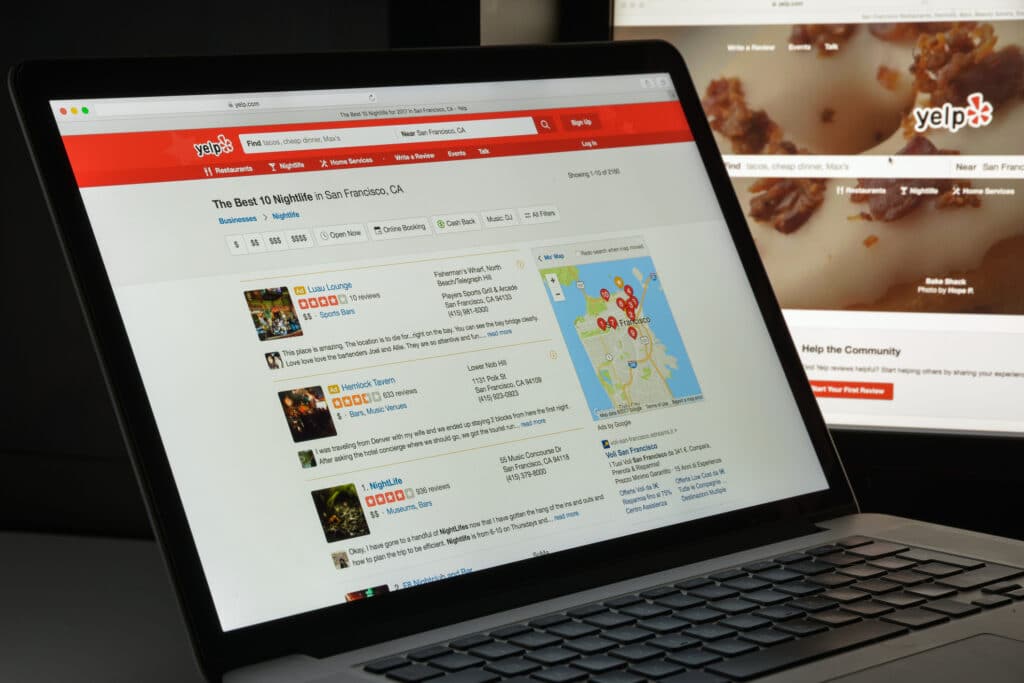
And here's the part nobody talks about: Yelp is quietly one of the biggest suppliers of review content to the machines. SOCi's 2026 data found Yelp accounts for 10.5% of the citations large language models use for local queries — while brands respond to a pathetic 3.1% of their Yelp reviews. Read that again. Yelp is an open lane: big AI influence, nearly zero owner competition. If you're in food, hospitality, or personal services in a metro, ignoring Yelp is leaving money on the table your competitors are too lazy to pick up. Yelp's role in local search is bigger than its app usage suggests — see Yelp Is Suing Google. Local Owners Should Pay Attention for why.
Where does Facebook's review power really live?
Not in search. In the friend network.
Facebook reviews get read by friends-of-fans. When your customer leaves a review on your Facebook page, it doesn't just sit there like a Google review — it travels. It shows up in feeds. Mutual friends see it. "Sarah reviewed Tony's Plumbing" carries a different weight than five anonymous stars, because Sarah is a real person the reader actually knows. That's social proof with a face on it.
The data backs the split personality: Facebook is where 34% of reviews get written — second only to Google — even though it's rarely the first place anyone searches. And BrightLocal's study of the sources AI platforms cite found Facebook in the citation mix at 2.23% — small, but present, and growing as social signals get measured for the first time. Facebook is your referral engine wearing a review costume. Feed it accordingly.

If you only have an hour a week, which platform do you feed first?
Google. Then Yelp if you're in the Yelp categories. Then Facebook. In that order. Every time.
Here's the pecking order, and it's not close:
1. Google first. It's where 71% of review readers go, it owns the moment of decision, and it supplies 28.6% of the citations AI assistants use when recommending businesses. One platform, three audiences: searchers, Maps users, and the robots. No other platform gives you that.
2. Yelp second — if you're in food, drink, beauty, hospitality, or local services. If you're a B2B consultant, skip it. But if customers choose you with their stomachs or their mirrors, Yelp's 10.5% share of AI citations against a 3.1% owner response rate is the single most neglected opportunity in local reviews.
3. Facebook third — as the amplifier. Ask happy customers to review you there specifically because their friends will see it. It's not where strangers find you; it's where strangers' friends vouch for you.
And whatever you do, don't let a fake review poison any of them — Fake Reviews Erode Trust: How Honest Businesses Win shows how honest owners fight back.
Your reviews aren't a popularity contest. They're real estate — and you only collect rent on the lot where the buyer actually shops. Now go feed the right lot.
— Jack
By the way... do you have a plan for collecting reviews in your business? Don't let it intimidate ya. Go to ReputationGenius for the plan and the tools to make it easy and reliable — for you and your team. Click here.
P.S. One platform done well beats three done badly. Pick your first lot this week.
